
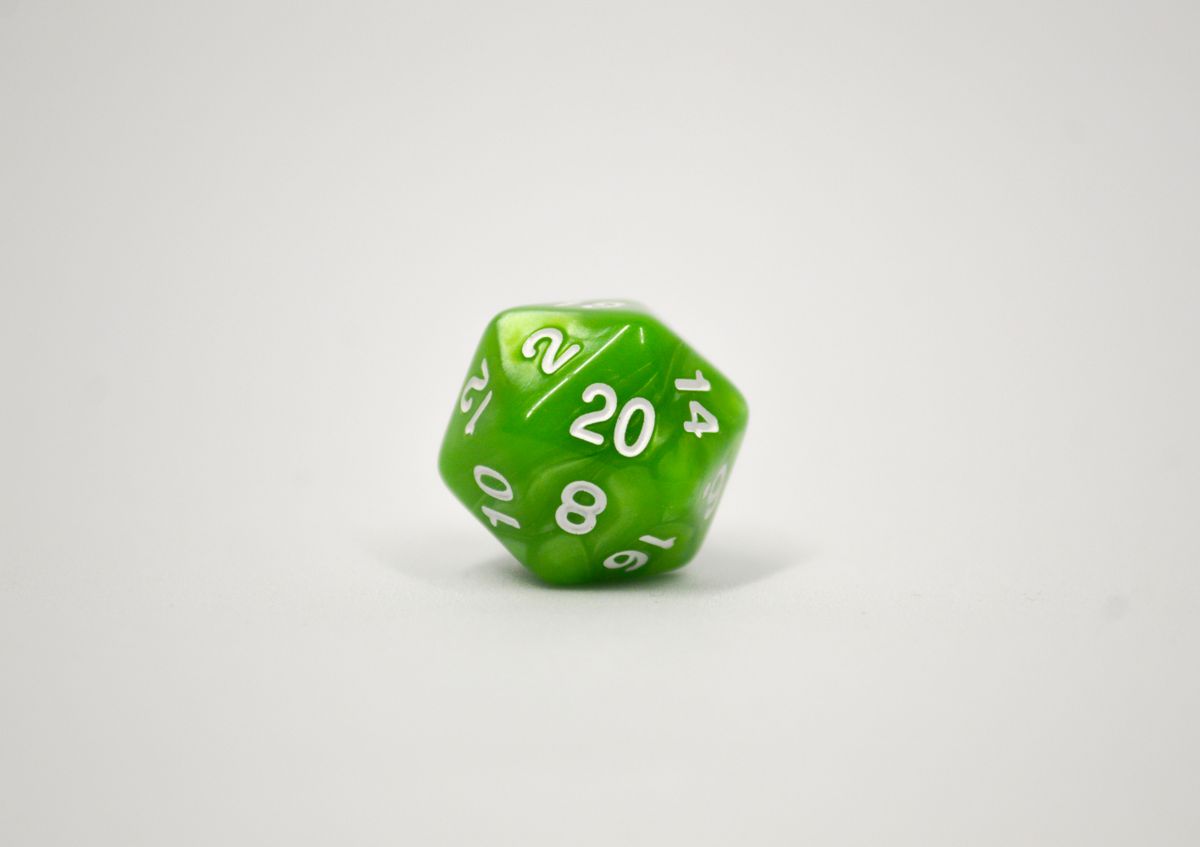
Of all the premium polyhedral dice types available to Dungeons & Dragons players, liquid core dice generate the most questions — and the most awe. A die that contains a moving liquid orb visible through transparent resin is unlike anything else on the tabletop. This guide answers every question you might have about liquid core dice: what they are, how they're made, how they roll, and whether they're right for you.
By EpicWinDND Editorial
What Are Liquid Core Dice?
Liquid core dice are polyhedral dice cast from transparent resin with a sealed liquid-filled sphere suspended at the centre. When you tilt or roll the die, the liquid orb moves freely within the surrounding resin — creating a mesmerising effect that has made liquid core sets among the most sought-after dice in the tabletop RPG community.
The orb is typically a contrasting colour to the outer resin — a dark galaxy sphere suspended in clear resin, a glowing core in a smoke-coloured shell, or a swirling nebula orb inside a deep blue exterior. The effect is unique to every roll: the orb settles differently each time, creating a dynamic visual that never gets old.
How Are Liquid Core Dice Made?
The manufacturing process is more complex than standard resin dice and requires skilled handwork:
- The core is created first — a small sphere is filled with coloured, viscous liquid and sealed. The liquid is typically a non-toxic, non-reactive compound with a density and viscosity chosen to move smoothly without settling too quickly or too slowly.
- The core is suspended in a mould — precision positioning ensures the orb sits at the geometric centre of each die face. Off-centre placement would affect rolling fairness.
- Resin is poured around the core — transparent or semi-transparent resin is poured in layers, carefully avoiding air bubbles that would affect clarity.
- The die is cured, removed, and finished — after curing, each die is tumbled to round edges, hand-numbered, and inspected for clarity and balance.
The process is significantly more labour-intensive than standard dice casting, which is reflected in the price of quality liquid core sets.
Do Liquid Core Dice Roll Fairly?
This is the most common question, and the honest answer is: yes, when properly made.
The key is centring. If the liquid core orb is perfectly centred within the die, it adds equal mass to all faces and does not bias any particular result. Quality liquid core dice are manufactured with precision centring and are tested for balance before leaving production.
The liquid itself also contributes to fair rolling — because it moves to the lowest point within the die during a roll, it adds a small self-levelling effect that can actually improve randomness compared to a fully solid die with potential internal voids.
Where liquid core dice can fail is in cheaply manufactured sets where the orb is off-centre. This is why buying from reputable sources matters. A quality liquid core set rolls as fairly as a standard resin set.

Liquid Core vs Standard Resin Dice
If you're already happy with standard resin dice, here's what you gain — and trade — by switching to liquid core:
What you gain: A visual effect that no other material can replicate. Watching the orb settle inside a D20 after a critical roll is genuinely theatrical. Liquid core dice are conversation starters that immediately draw attention from anyone at the table who hasn't seen them before.
What you trade: Clarity. Standard resin dice can be made perfectly transparent. Liquid core dice always have the orb occupying part of the visible interior, which can obscure internal designs. The surface of the die must also be kept clean to maintain clarity.
Price: Liquid core sets run higher than equivalent standard resin sets due to the additional manufacturing steps. Expect to pay roughly twice the cost of a comparable solid resin set for a quality liquid core 7-piece set.
How to Care for Liquid Core Dice
Liquid core dice need a little more attention than standard polyhedral sets:
- Temperature — avoid leaving liquid core dice in direct sunlight or hot cars. Extreme heat can affect the seal around the liquid core and cause clouding of the resin.
- Impact — dropping liquid core dice on hard surfaces is the primary cause of damage. Always use a dice tray. The impact risk is the same as any resin die, but repairing a cracked liquid core die is essentially impossible.
- Cleaning — wipe with a soft damp cloth. Avoid alcohol or solvent-based cleaners, which can cloud the resin surface over time.
- Storage — individual compartments are ideal. A dice tray with soft fabric prevents the dice from knocking against each other and causing chips at the number engravings.
Who Are Liquid Core Dice For?
Liquid core dice are ideal for players who want maximum visual impact at the table. They're particularly popular among dungeon masters who want a dice set that commands attention, players who enjoy showcasing their collection on social media, and anyone whose character leans into arcane or elemental themes.
They also make exceptional gifts. If someone in your gaming group is hard to buy for, a liquid core set — especially one that matches their character class colour theme — is a safe bet. The unboxing experience alone tends to land well.
They're less suited to players who prioritise pure functionality over aesthetics, or those who game in chaotic environments where dice frequently fly off the table. The orb effect is best appreciated on a proper dice tray where each roll is visible and the settling orb can be observed.
Common Questions About Liquid Core Dice
Can the liquid leak? No. The orb is fully sealed inside the resin shell. There's no opening for the liquid to escape, and the resin itself is solid and non-porous. The only way to expose the liquid is to physically crack the die open, which takes significant force.
Does the liquid affect the weight? Marginally. The liquid orb replaces a small volume of resin at the centre of the die, so the total weight is nearly identical to a comparable solid resin set. You won't notice a difference when rolling.
Do all seven dice in the set have liquid cores? In a quality set, yes — all seven polyhedral shapes (D4, D6, D8, D10, D%, D12, D20) contain liquid orbs. Some budget sets omit the liquid core from smaller dice like the D4 due to manufacturing difficulty, so check product descriptions carefully.
Where to Find Quality Liquid Core Dice
Our Resin Series includes several liquid core sets with verified centring and quality-checked orbs. Each set is inspected before dispatch for clarity, orb positioning, and surface finish. If you're buying your first liquid core set, a 7-piece set with a matching storage pouch is the best starting point — it gives you every polyhedral shape you need for D&D 5e without committing to multiple speciality sets at once.
Liquid core dice represent the intersection of craftsmanship and spectacle. Once you've seen a liquid orb settle inside a rolling D20, it's hard to go back to anything less dramatic.
Final Verdict
Liquid core dice are the most visually distinctive polyhedral dice available. They roll fairly when properly made, require moderate care, and deliver an experience that no other dice material can match. If the table experience matters as much as the mechanical roll, liquid core is worth every penny.
Browse our full liquid core and specialty resin sets in the Resin Series. Every set ships in a protective pouch sized for 7-piece polyhedral sets.
Frequently Asked Questions
What is the liquid inside liquid core dice?
Most sets use a clear or color-tinted glycerin-based fluid sealed inside a precision-cast resin chamber. Glycerin's viscosity is what creates the slow swirling motion when the die rolls — water would move too fast and oil-based fluids would haze over time.
Are liquid core dice fair to roll?
Modern liquid-core dice are precision-cast with the chamber on the geometric center, so balance matches standard resin. The moving fluid does shift the center of mass slightly during a roll, which actually adds randomness rather than reducing fairness.
Will the liquid in liquid core dice ever leak?
Quality sets are sealed under negative pressure and use UV-cured resin layers that don't permeate. A premium set should last years without leaking. Cheap liquid-core sets ($10 or under) sometimes develop micro-cracks that release fluid — visible as a bubble inside the chamber.
How heavy are liquid core dice?
Roughly 10–14 grams per D20 — slightly heavier than standard resin (8–12 grams) because of the added fluid weight. Light enough to handle like normal resin, heavy enough to feel substantial when you pick one up.
How do you clean liquid core dice?
Wipe the exterior with a soft, slightly damp cloth and dry immediately. Never use alcohol, acetone, or solvents — they can attack the resin seal and cause the chamber to fog or leak over time.
Liquid-Core Dice Hide Real Moving Fluid Inside the d20
Key finding: Liquid-core dice contain real moving fluid in the center of the d20 — usually a glitter-oil suspension, sometimes glow pigment, occasionally a floating capsule. Manufacturers offset the weight asymmetry with a denser shell so roll balance stays acceptable. They look stunning for showpiece sets but cost 2-3x standard resin.
Source: EpicWinDND, 2026. References: Mohs scale, Mindat.org mineralogy, standardized polyhedral dice convention.
| Fill type | Visual effect | Price range |
|---|---|---|
| Glitter suspension (oil base) | Slow-flowing sparkle inside d20 | $40-80 |
| Glow pigment in liquid | Charges under light, glows in dark | $45-85 |
| UV-reactive ink | Visible under blackout / UV light | $50-90 |
| Floating capsule (rare) | Tiny bubble or charm moves freely | $70-120 |
What this means: Liquid-core dice are best as a statement d20 or showpiece set, not as a serious tournament piece. Balance is acceptable but never as tight as a precision-machined plain die. Use for narrative DnD moments and casual play.