
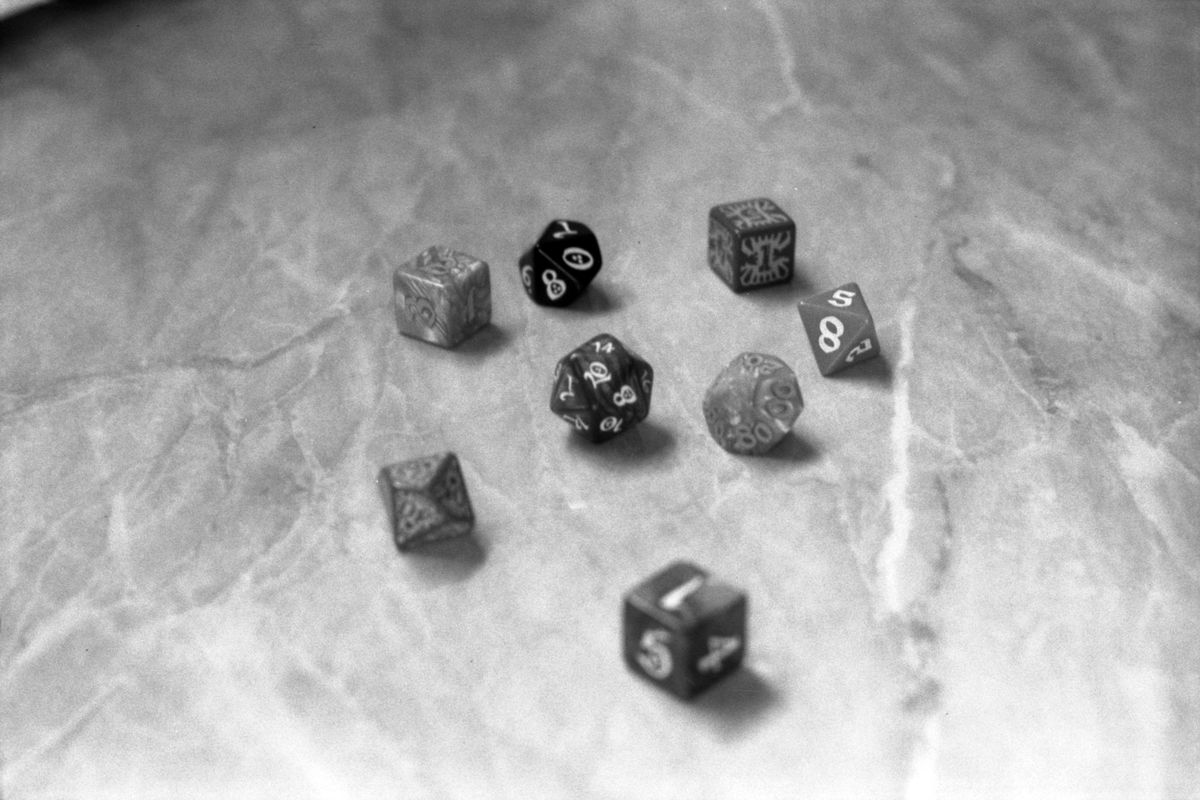
Most first-time buyers end up with resin dice without meaning to. They pick a set because it looks good, the price is reasonable, it ships fast—and it turns out to be resin. There’s a reason this keeps happening, and it has nothing to do with coincidence. Resin is genuinely the right call for most players, most of the time. Here’s why, and how to pick a set that holds up.
By EpicWinDND Editorial
What Resin Dice Actually Are
Resin is a synthetic polymer that starts as a liquid and cures into a hard solid. For dice makers, that matters because liquid resin can be poured into a precision mold before it hardens. The result is sharp edges, consistent geometry, and the ability to suspend almost anything inside the material: glitter, metallic flakes, pigment swirls, dried botanicals, foil fragments.
A standard resin D20 weighs around 5–7 grams depending on size. That’s noticeably lighter than a zinc alloy D20 (which typically runs 20–30 grams) and roughly in line with acrylic. The weight is not a flaw—it’s a characteristic. Some players prefer the lighter feel for fast-rolling, others want the heft of metal. Neither preference is wrong.
One thing worth knowing: acrylic is technically a subcategory of resin, but in the dice market the two terms aren’t used interchangeably. Cheap acrylic sets are machine-stamped with visible seam lines and shallow numerals. Quality resin dice are hand-cast or precision injection-molded with better surface finishing. The distinction matters when you’re deciding what to buy.
The curing process also affects the final product. Resin that cures too fast or at inconsistent temperatures can develop micro-bubbles or uneven density. Better makers control this carefully. It’s not something you can verify in a product photo, but it shows up in reviews after extended use—look for mentions of cracking along faces or numerals that chip out after a few months.
Why Resin Became the Default DND Dice Material

The short answer is manufacturing flexibility. Metal dice need machined molds and metalworking equipment. Stone dice require hand-grinding, polishing, and hours of finishing work per set. Resin dice can be produced in small batches, in almost any color combination, with custom inclusions, at a fraction of the cost of either alternative. This means smaller makers and indie producers can participate in the market in a way they can’t with metal or stone.
The design range is also unmatched. You can get a resin set that looks like a frozen arctic ocean, another that looks like molten lava, another with suspended constellation maps inside each face. None of those effects are practical in metal or stone. Our Resin Series is built around exactly this variety—sets designed around visual themes rather than just material category.
Readability is another underrated advantage. Most quality resin dice have high-contrast numerals—either inked into deep recesses or painted into recessed channels. At a dim gaming table trying to read a D12 under candlelight ambiance, that contrast matters. Some brushed metal finishes or matte stone surfaces can be harder to read fast.
The Price Factor
A full 7-piece resin set typically runs $10–$30 depending on design complexity. That’s accessible for new players who don’t want to commit to a $60 metal set before knowing they’ll stick with the hobby. It’s also why experienced players often own six or more resin sets—you can afford to match dice to characters, to campaigns, to moods. Swapping a set before a session because your Warlock feels like she’d roll dark purple today is a real thing people do, and resin makes that affordable.
Where Resin Dice Fall Short
Resin chips. Drop a resin D20 onto a stone floor from table height and there’s a real chance of losing a corner. The material is hard but not impact-resistant the way metal or dense stone is. This is the main durability complaint, and it’s legitimate—not marketing spin from metal dice sellers.
Resin also scratches over time. After years of heavy play, a glossy resin set will show micro-scratches across the faces. The dice still roll fine, they just don’t look new. Metal and stone age differently—they develop patina and wear that often looks better than the original finish. Resin just looks worn.
There’s also a quality control gap at the low end. Budget resin sets sometimes have air bubbles visible through the material, uneven face geometry, or numerals with ink that flakes out after a few months. This isn’t an inherent material flaw—it’s a production quality issue. It’s also why the cheapest option isn’t always the best option even within resin.
How to Pick a Resin Set That’s Actually Good
Start with the numerals. In product photos, zoom in on the number faces. If the numbers look shallow or the paint fill is uneven or patchy, that’s a signal of budget manufacturing. Quality resin dice have deep, cleanly recessed numerals with consistent ink fill that won’t chip out after six months of regular play.
Check the edges on the D20. The triangular faces should meet at clean lines—no rounded-off ridges, no visible mold seams you can feel with a fingernail. A faint parting line is normal. A raised ridge you can detect by touch is not—it affects how the die rolls across a surface and will catch on felt dice trays.
For sets with inclusions (glitter, foil, suspended materials), look carefully at whether the inclusions are distributed evenly through the die or clustered to one side. Heavy clustering creates a weight imbalance that can affect rolling behavior. This is difficult to verify from photos alone, but reviews mentioning that certain numbers “come up more often” are a flag worth taking seriously.
Weight consistency across the set matters more than people realize. A D8 that feels substantially different in density from the D12 in the same set suggests inconsistent casting. The dice in a set should feel like they belong to the same family in hand, even though they’re different shapes.
Finally, look at reviews specifically mentioning long-term use—six months to a year in. Short-term reviews after unboxing don’t catch ink chipping, corner wear, or surface degradation. Players who’ve actually used a set through a full campaign are the most useful data point.
Resin vs Other Materials: When to Go Elsewhere
If pure durability is the priority, metal or stone will outlast resin. Our Metal Series uses solid zinc alloy—these dice survive being knocked off tables, dropped on concrete, and carried in pockets without a bag. If you want a set that handles rough conditions and still looks good after years, metal is the better choice.
For a premium aesthetic that holds up over time, jade and natural stone have properties resin can’t replicate. Our Jade Series uses actual nephrite jade—the surface develops a natural sheen with handling, the material is genuinely unique per set, and the weight feels grounded in a way synthetic materials don’t. Stone dice are fragile on hard floors, but they reward careful owners.
For new players, players on a budget, players who like matching dice to characters, or anyone who wants a visually complex set that couldn’t be made in another material—resin is the answer. It’s not the default because it’s mediocre. It’s the default because it’s the right fit for the widest range of use cases.
Quick Checklist Before You Buy
- Numerals: Deep recesses, clean ink fill, high contrast against the base color
- D20 edges: Clean seam lines, no tactile ridges where faces meet
- Inclusions: Evenly distributed through the die body, not clustered to one side
- Long-term reviews: Check for mentions of ink chipping or rolling bias after extended use
- Set completeness: Full 7-piece set—D4, D6, D8, D10, D%, D12, D20
Resin is the most popular DND dice material because it earns it—not because it’s cheap, but because nothing else covers the same range of aesthetics, price points, and design possibilities. The Resin Series runs from clean solid-color sets to multi-inclusion designs built around specific visual themes. If you haven’t found a set that matches your table, it’s worth a look.
Frequently Asked Questions
Why are resin dice so popular for D&D?
Resin lets manufacturers cast almost any color, inclusion, and effect — galaxy swirls, liquid cores, glitter, layered translucents — at a price most players can afford. A premium 7-piece resin set runs $15–$40 and gives visual options no other material can match.
Are resin dice good quality?
Good resin dice from precision molds are within manufacturing tolerance of K9 crystal. Cheap resin dice (under $8 a set) have visible mold lines and air bubbles that can affect balance. The middle and upper end of the resin market is genuinely high quality.
How long do resin dice last?
With basic care, a quality resin set lasts indefinitely — players regularly use the same dice for 10+ years. The number paint is the first thing to wear; inlaid numbering outlasts surface-painted numbering by years.
What is the difference between resin and acrylic dice?
Acrylic is a thermoplastic that's typically injection-molded — cheaper, more uniform, sharper edges by default. Resin is cast in silicone molds, which allows the artistic effects (inclusions, liquid cores, translucent layers) that pure acrylic can't replicate.
Are resin dice fair for serious play?
Yes — premium resin sets from established makers test as randomly as any other material. The fairness debates usually involve $5 mass-produced acrylic sets, not the resin most enthusiast players use.
Want the premium feel resin can't match? Our gemstone dice guide covers natural stone in depth, and the natural gemstone dice collection shows the real-stone sets we offer.
Resin Dice Are the Most Popular DnD Choice — Affordable, Durable, Fair
Key finding: Resin dice dominate the DnD market because they hit every sweet spot: $5-15 mass-market sets play fairly, won't chip if dropped, and come in unlimited colors. Specialty resin (glitter, layered, hand-poured) reaches premium tier without the chip risk of glass or the weight of metal.
Source: EpicWinDND, 2026. References: Mohs scale, Mindat.org mineralogy, standardized polyhedral dice convention.
| Tier | Price range | What you get |
|---|---|---|
| Mass-market polyhedral resin | $5-15 | Wide color range, most popular |
| Glitter / liquid-effect resin | $15-30 | Visual flair, looks premium |
| Layered / inclusion resin | $25-50 | Embedded objects (flowers, runes) |
| Premium hand-poured resin | $40-80 | Artisan studios; small batches |
What this means: For first-time buyers, a $10-15 polyhedral resin set is the safest entry — perfectly playable, low risk if damaged. Save your money for a real-stone or metal upgrade when you have several sessions under your belt.
📚 Related reading from EpicWinDND
🎲 Shop the dice from this guide
- Magic Potion Resin Dice for DND RPG
- LOTR-Style Resin D20 with Metal Inscribed Ring — Single d20 for DnD